|
Links
|
What is MHC and what does it do? |
|
|
What is MHC and what does it do? What is the molecular basis of chimpanzee resistance to SIVcpz? Are there allelic variants in human population that are protective against HIV? How are humans adapting to selection pressures produced by HIV? What will the future bring?
|
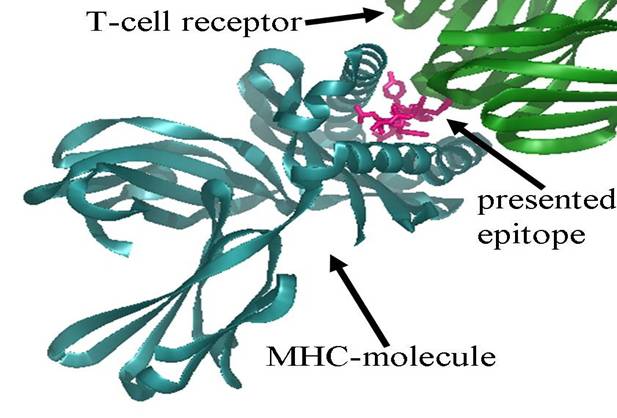
For many years scientists have appreciated the essential role that MHC class I molecules play in the immune defence against intracellular infections in both human and non-human primates (2). MHC class I antigens are expressed on nearly all cells and bind both intracellular and foreign peptides. During an infection Class I MHC molecules present pathogenic peptides to the immune system which triggers the lysis of infected cells by CD8+ T cells (4). As the assorted MHC molecules are capable of binding and presenting disparate peptides, an association exists between particular MHC alleles or molecules as well as the susceptibility or resistance to specific ailments (4). Moreover, seeing that it is advantageous to increase the number of foreign proteins that are recognized by the immune system, indicative of increased MHC heterozygosity, all MHC class I loci continually evolve under extreme balancing selection (4; 12). Specifically, the high degree of polymorphism present at MHC class I loci in humans allows for a large number of antigens to be presented to and subsequently destroyed by CD8+ T cells (4). There are 3 major constituents of MHC class I loci: HLA-A, HLA-B and HLA-C each with slightly different roles in the human immune system. HLA-B appears to be under more intense diversifying selection than either HLA-A or HLA-C. This is evidenced by the fact that there are 563 HLA-B alleles, 309 HLA-A alleles and 167 HLA-C alleles (4). However, the significance of the increased rate of diversification at the HLA-B locus has yet to be discovered.
|