|
Links
|
Where did the HIV virus come from? |
|
What is MHC and what does it do? What is the molecular basis of chimpanzee resistance to SIVcpz? Are there allelic variants in human population that are protective against HIV? How are humans adapting to selection pressures produced by HIV? What will the future bring?
|
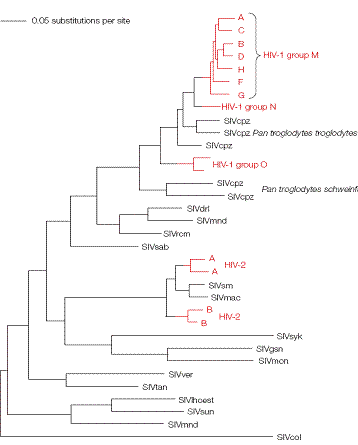
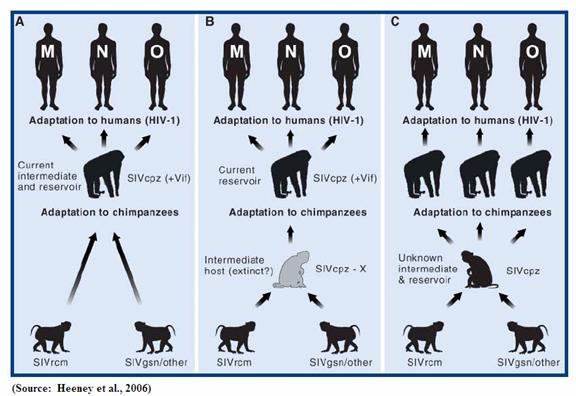
Although there are two distinct HIV viruses, (HIV-1 and HIV-2) HIV-1 has proven to be substantially more devastating (9). Both HIV-1 and HIV-2 are classified as zoonotic diseases as they are the result of cross species transmission events of lentiviruses from non-human primates. Through extensive research it was determined that HIV-2 originated in SIVsm of sooty mangabeys (Cercocebus atys). Additionally, empirical evidence suggests that there have been at least 8 cross species transmission events of SIVsm (3). Conversely, researchers have ascertained that HIV-1 is a derivative of a specific strain of simian immunodeficiency virus (SIVcpz) from a sub-species of chimpanzee (Pan troglodytes troglodytes) (3; 9; 10). HIV-1 crossed the species boundary and entered the human population on a least 3 independent occasions (3; 9). Each transmission event gave rise to a different group of HIV-1; M, N, O. Notably, although HIV-1 group M is a product of only one of the cross-species transmission events, HIV-1 group M is also progenitor of the current AIDS epidemic (3; 9; 10). Since it emergence, HIV-1 group M has diverged into 11 subtypes due to the diversifying selection pressure placed on the virus by its host in addition to having undergone numerous recombination events (3). The figure which is adapted from Sharp et al. illustrates the phylogenetic relationship that exists between the HIV-1 variants as well as how these variants are situated with respect to different strains of SIV viruses As it is now clear that HIV-1 is derived from SIVcpz, attention has turned to the disentanglement of the origin SIVcpz as well as the source of the SIVcpz reservoir. SIVcpz is hypothesized to be a recombinant virus comprised of lentiviruses from the red capped mangabey (SIVrcm) and at least one lentivirus from the spot nosed monkey, or a closely related lineage (SIVgsn) (3; 9). Data from Heeney et al. demonstrates that chimpanzees can be simultaneously infected by multiple lentiviruses, thus it is possible that the recombination event that gave rise to the contemporary form of SIVcpz occurred in chimpanzees (3). If this hypothesis is correct, chimpanzees would represent the current SIVcpz reservoir. Although the aforementioned theory is widely accepted, the limited distribution of SIVcpz within the chimpanzee population (SIVcpz is only prevalent in 2 of the 4 chimpanzee sub-species) necessitates speculation about the validity of this hypothesis (3). Accordingly, two additional hypotheses have been proposed. These hypotheses differ with respect to the location of the current SIVcpz reservoir. The first contends that chimpanzees are the current SIVcpz reservoir however, the viral recombination which gave rise to SIVcpz occurred in an intermediate host (3). Conversely, the second hypothesis suggests that a yet to be identified non-human primate is currently the location of the SIVcpz reservoir and that this primate was also the site of the recombination events that generated SIVcpz (3). Figure 2 provides a pictorial representation of the 3 hypotheses
|